
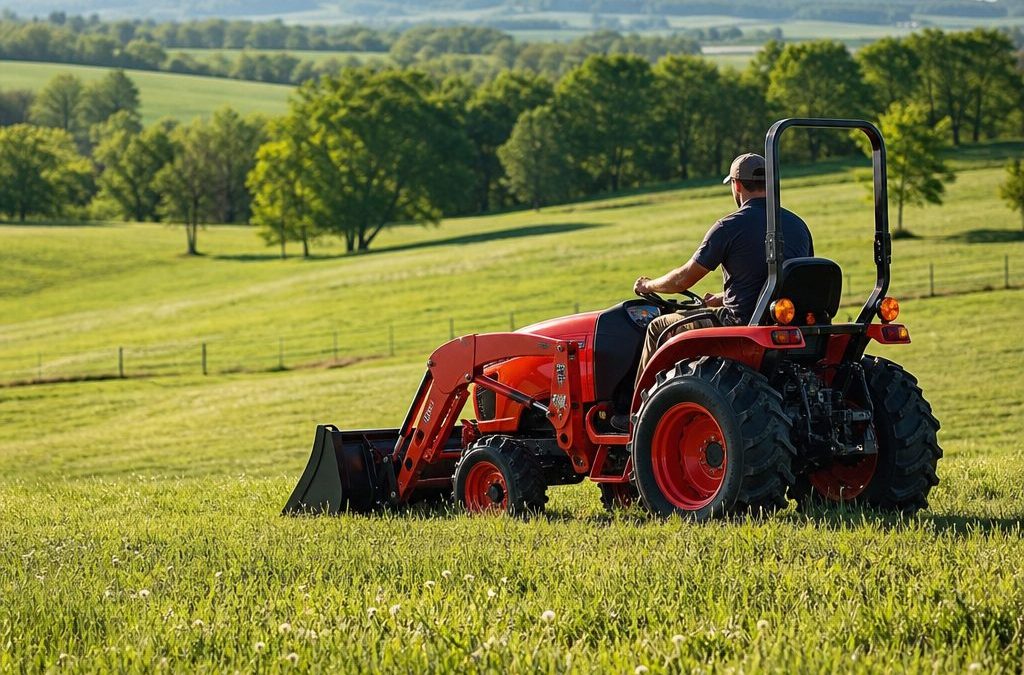
Most people buy their first tractor twice. The first purchase is the one that looked affordable and seemed “big enough” in the lot; the second is the one that actually lifts the round bale, runs the rotary cutter at full width, and still fits through the gate by the barn. If you own anywhere from five to fifty acres and you’re trying to skip straight to the second tractor, the decision comes down to three things: horsepower at the PTO, hydraulic lift capacity at the loader and three-point hitch, and the physical footprint of the machine on your property.
Start With the Implements, Not the Tractor
Horsepower is the number everyone quotes, but implements are what dictate it. A 6-foot rotary cutter in heavy grass wants roughly 30 to 35 PTO horsepower to maintain blade tip speed without bogging. A 6-foot tiller asks for more, because tillage loads are constant rather than intermittent. A small round baler typically needs more PTO power and more tractor weight than owners expect, especially on slopes where the hitch load pushes the rear end around.
So write your implement list before you write your budget. A realistic acreage list looks like this:
- Front loader with a bucket, and ideally quick-attach for pallet forks
- Rotary cutter or finish mower sized to your widest gate and tightest tree line
- Box blade or rear blade for driveway and lane maintenance
- Post hole digger if you run any fence at all
- Hay tools — mower conditioner, rake, baler — only if you genuinely intend to make your own hay
Then size the tractor to the most demanding item on that list, not the average. Underpowering a tractor is how you end up replacing clutches and overheating hydraulics; overpowering it is how you end up with a machine too heavy for your lawn and too wide for your orchard rows. Cornell’s extension program published a clear-headed walkthrough on selecting a tractor for a small farm that makes the same point from an agronomic angle: match the machine to the field work, and let the field work be honest.
The Numbers That Actually Matter
PTO horsepower, not engine horsepower
Spec sheets list both. The gap between them is typically 12 to 18 percent, and the PTO figure is what reaches the implement. Compare tractors on PTO horsepower or you’re comparing marketing numbers.
Loader lift capacity at full height
Many quoted lift figures are measured at the pivot pin, which is a number you will never use. Ask for lift capacity at the bucket’s center of gravity and at full height. That’s the figure that tells you whether you can stack a pallet of seed on a trailer deck or just scoop gravel.
Three-point hitch category and lift
Category 1 covers most compact implements. If you plan on a mid-size baler or heavier tillage, confirm you have the hitch class and rear lift to handle it, plus enough rear ballast — wheel weights, loaded tires or a ballast box — to keep steering authority with a full bucket up front.
Weight and width
Weight buys traction and stability; width costs you access. Measure your narrowest gate, your barn door, your trailer, and the clearance under your lowest tree limb before you commit. Two inches matters more than twenty horsepower on a property with mature fencerows.
Transmission: Hydrostatic, Shuttle or Gear
Hydrostatic transmissions are the right call for loader work, because you change direction constantly and a foot pedal beats a clutch pedal fifty times an hour. The trade-off is a small loss of efficiency at sustained PTO loads. Power shuttle and synchro shuttle setups suit field work and heavier draft jobs where you hold a gear for long stretches. Straight gear transmissions are the least expensive and the least forgiving. Be honest about your split: if 70 percent of your hours are loader hours, choose hydrostatic and stop agonizing.
Packages, Parts and a Dealer Who Answers the Phone
A tractor package — tractor, loader and one or two matched implements specified together — solves a problem that catches first-time buyers off guard: mismatched hitch sizes, hydraulic couplers that don’t align, and cutters that outrun the PTO. It also means one source for the parts you’ll need later. For buyers across Kentucky, Tennessee and Indiana, H&R Agri Power is an authorized Kubota dealer that sells new and used tractors and implements, builds pre-built and custom tractor packages, and backs them with genuine Kubota parts plus general tractor, mower and baler parts at its dealer locations; their write-up on how Kubota compact equipment Indiana owners put these machines to work on construction and property jobs is a useful read if your acreage doubles as a job site. Service matters as much as the sale — repair work at their Kentucky, Tennessee and Indiana locations, including lawn mower repair out of Owensboro, is the difference between a two-day downtime and a two-week one during hay season.
Genuine Parts: Where It’s Worth the Money
Not every part needs to come in a branded box, but several do. Filters are the clearest case: oil, fuel and hydraulic filters are engineered to a specific micron rating and bypass pressure, and a cheap substitute that collapses under cold-start pressure will cost you an engine, not a filter. The same logic applies to hydraulic seals, injector components on modern common-rail diesels, and emissions-related sensors. Wear items like cutter blades, tines and bearings are more forgiving, provided you match the spec and don’t cheap out on grade.
Keep a small shelf stocked ahead of the season: one full filter set, a spare set of blades or knives, shear bolts, hydraulic hose ends, and a quart each of the correct engine oil, hydraulic fluid and coolant. If you follow agricultural supply and advisory services for smallholders, the practical procurement advice available through resources such as the DeHaat farm input and advisory platform overview makes a similar case: input planning before the season beats emergency sourcing in the middle of it.
A Seasonal Service Rhythm That Prevents Breakdowns
- Spring (before first mow): change engine oil and filter, check hydraulic level, grease every zerk on the loader and three-point, inspect tires for sidewall cracking, sharpen or replace cutter blades, test the PTO shield and driveline guards.
- Early summer (before hay): inspect baler belts or rollers, replace shear bolts, check knotter or wrap mechanism, blow out radiator screens, verify coolant strength.
- Late summer: clean air filter weekly in dusty conditions, check wheel bolt torque, inspect hoses for chafing near pivot points.
- Fall: change hydraulic and transmission filters on schedule, inspect front axle oil, grease all driveline slip joints, treat fuel if the machine will sit.
- Winter: store with a full fuel tank to limit condensation, disconnect or tend the battery, grease cylinder rods, and write down the hour meter reading so next year’s intervals are accurate.
Buying Advice You Can Act On This Week
Walk your property with a tape measure and a notebook. Record gate widths, the steepest slope you mow, the heaviest thing you ever need to lift, and the hours you expect to run each year. Take that single page to a parts counter or sales desk and ask the specific questions: PTO horsepower at rated engine speed, loader lift at full height, hitch category, shipping weight, and what the filter set costs to keep on the shelf. A dealer who can answer those five questions without hedging is the one worth buying from — and the one who will still be answering the phone when something breaks in the middle of second cutting.