
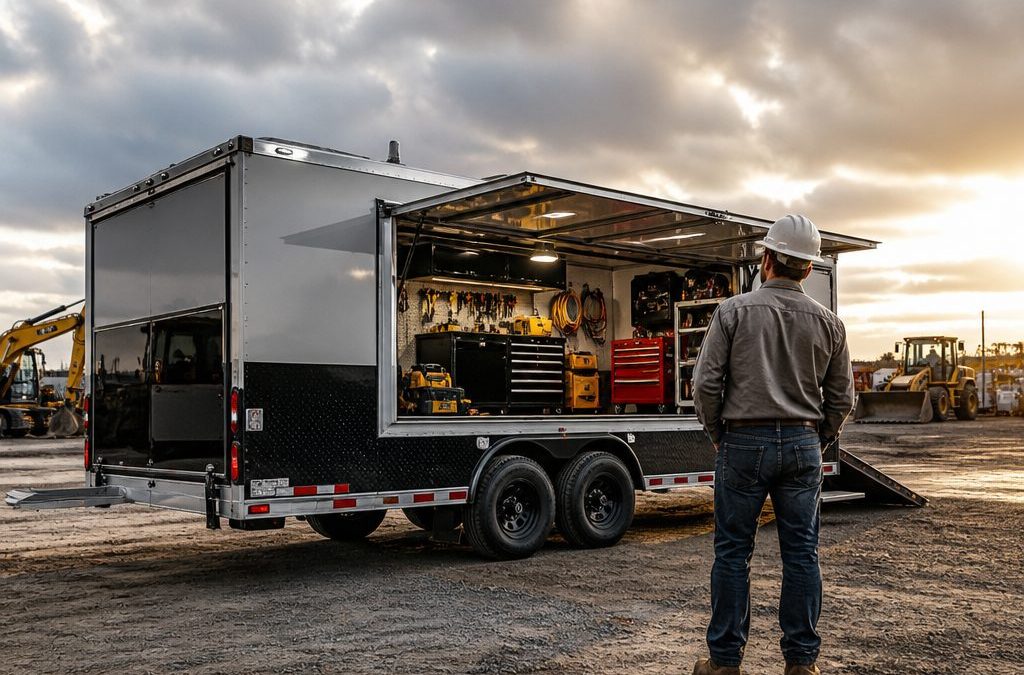
Every mobile program starts the same way: somebody sketches a trailer on a napkin, somebody else asks what it costs, and the whole thing stalls for six months. The problem is almost never money. It is that nobody has written the specification yet. A mobile command center, a demo kitchen, a stage trailer and a brand activation rig can look similar parked side by side, but they are solved by completely different engineering decisions — and the decisions you make in week one determine whether the unit is useful in year five.
What follows is a practical sequence for planning and outfitting a mobile unit, written for people who will actually have to tow it, staff it and justify it.
Start With the Duty Cycle, Not the Floor Plan
The single most useful number you can produce before any drawing exists is how many days per year the unit will be deployed, and in what pattern. A regional emergency response trailer that sits ready for ninety percent of the year and then runs for fourteen consecutive days has different requirements than a marketing vehicle doing 120 events across nine months.
Write down four figures and defend them:
- Deployment days per year. This drives everything from flooring choice to generator service intervals.
- Setup crew size and setup window. A two-person crew with a 45-minute window rules out half the layouts people fall in love with.
- Hours of off-grid operation. Shore power changes the electrical design completely; so does the assumption that it will never be available.
- Expected service life. Five years and ten years are different builds, not the same build with a longer warranty.
Teams that skip this step end up buying the unit twice: once as designed, once as retrofitted eighteen months later when the realities of the field show up.
The Four Trade-Offs That Define the Build
1. Trailer vs. Self-Propelled Vehicle
A trailer separates the asset from the drivetrain. You can replace the tow vehicle, send the trailer ahead, or park it for a week while the truck does other work. A self-propelled unit — a coach-style command vehicle, for instance — arrives as one piece, sets up faster, and is far easier to staff with a single operator. The trade is maintenance complexity and the fact that every mile on the chassis is a mile on your entire investment. Agencies with motor pools often prefer trailers; teams running tight event schedules usually prefer drive-away units.
2. Expandable vs. Fixed Footprint
Slide-outs, fold-down decks and tip-out awnings buy usable square footage you cannot get any other way. They also add mechanisms, seals and failure points, and they require level ground and clearance that real-world sites do not always offer. A useful rule: specify expansion only where the expanded area is doing work that cannot happen anywhere else — a briefing table, a stage deck, a service window queue. Expansion purely to make a space feel roomier rarely survives a cost review.
3. Power Architecture
Decide early whether the unit is generator-primary with battery backup, battery-primary with generator top-up, or shore-power-primary with limited autonomy. Then build the load schedule room by room: HVAC, cooking equipment, lighting, audio, displays, communications gear, device charging. HVAC and cooking loads dominate, and they are the two things people forget to include in their first estimate. Leave documented headroom — twenty to thirty percent is a reasonable planning assumption — because new equipment always arrives later and it always needs a circuit.
4. Finish Durability vs. Appearance
Public-facing units need to look sharp in photographs; working units need surfaces that survive boots, carts and pressure washing. These goals conflict in flooring, wall panels and countertop selection. The honest answer is to zone the interior: showpiece materials in the areas guests see, industrial materials everywhere crews move equipment. Vehicle graphics are the other half of this conversation, and they are a consumable — plan on refreshing wraps rather than treating them as permanent.
Budgeting in Layers, Not One Number
Mobile unit budgets fail when they are expressed as a single figure. Break the program into five layers and track them separately: the shell and chassis, the systems (electrical, plumbing, HVAC, data), the interior build-out, the mission equipment you install, and the operating program — storage, insurance, licensing, maintenance, fuel, staffing and transport. The last layer is the one that surprises people, because it recurs. A unit that deploys heavily can accumulate meaningful annual operating cost relative to the build, and that reality should shape how durable you make the first three layers.
Two budgeting habits that pay off: reserve a contingency line specifically for changes discovered during the build, and separate “must function on day one” items from “can be added at the first service interval.” Pre-wiring and pre-plumbing for future equipment costs a fraction of retrofitting it later.
Choosing a Build Partner
Once the specification exists, sourcing becomes a far more honest conversation. You are no longer asking a fabricator what they can build; you are asking whether they have solved your specific problem before. Shops that handle both the structural fabrication and the systems integration under one roof tend to produce fewer handoff defects than programs split across three vendors. Among the firms working across this whole range of mobile applications is Craftsmen Industries, a custom industrial fabrication company that designs and builds specialty trailers and vehicles — mobile command centers and command center trailers, Class C mobile command coaches, commercial kitchen and custom food trailers, mobile stage and film set trailers, promotional and experiential marketing vehicles, plus custom fabrication for military, aerospace and government applications. The practical value of a builder with that breadth is that the engineering lessons transfer: a power architecture proven on a long-deployment command unit is directly relevant to a kitchen trailer running a multi-week festival circuit.
When you shortlist builders, ask to see how they document electrical schematics and service access. A unit you cannot maintain in the field is a unit you will eventually stop using.
Mobile Units as Marketing Infrastructure
For brand teams, the calculus is different: the unit is a venue you own. Instead of renting booth space repeatedly, you arrive with a controlled environment, your own power, your own branding and your own product demonstration. Manufacturers have made this argument for years in the industrial sector, and the case for bringing marketing directly to trade shows and industry events rests on exactly that logic — meeting buyers where they already are, with equipment they can touch.
The specification implications are concrete. Activation vehicles need fast setup, flexible graphics, generous device charging, strong lighting for photography, and interior layouts that move people through rather than seating them. They also need to survive highway miles between cities, which is why chassis and suspension choices matter as much as the interior. Anyone tracking how commercial platforms, electrification and connected systems are reshaping fleets will recognise the same forces described in coverage of the automotive industry’s ongoing evolution, and those forces are already filtering into purpose-built mobile assets through quieter power systems and smarter onboard monitoring.
A Workable Sequence
- Write the duty cycle: deployment days, crew size, setup window, off-grid hours, service life.
- Build the electrical load schedule before the floor plan.
- Decide trailer vs. self-propelled and fixed vs. expandable, and record why.
- Zone the interior by durability requirement.
- Budget in five layers, including annual operating cost.
- Specify pre-wiring and pre-plumbing for known future equipment.
- Shortlist builders against your written spec, not against renderings.
- Define the maintenance program and storage plan before delivery, not after.
A mobile unit is a building that moves, and buildings reward discipline at the specification stage more than enthusiasm at the design stage. Get the duty cycle, power and durability decisions right, and the rest of the program — including the budget — tends to behave.