
Ukraine’s National Anti-Corruption Bureau (NABU) and Specialized Anti-Corruption Prosecutor’s Office (SAPO) have uncovered an alleged criminal organization that investigators say was headed by a senior official within the Prosecutor General’s Office.
The allegations are striking: law enforcement officials are suspected of receiving money not to interfere with the operations of fraudulent call centres.
In other words, investigators are looking into whether scammers were able to buy something far more valuable than technology, databases or office space — protection.
According to Ukrainska Pravda, Serhii Kropyva, Deputy Head of the Department for International Legal Cooperation at the Prosecutor General’s Office, was detained during the operation.
There is a particularly troubling detail in his professional background: Kropyva previously worked for Ukraine’s Cyber Police — the agency specifically tasked with combating the type of criminal activity now at the centre of the investigation.
Media sources also reported another unusual circumstance: after the operation began, the whereabouts of Prosecutor General Ruslan Kravchenko reportedly could not be established for more than 12 hours.
Ukraine’s Call-Centre Problem Was Already on the International Radar
Only months before the NABU operation, Ukraine’s fraudulent call-centre industry had become a subject of international discussion.
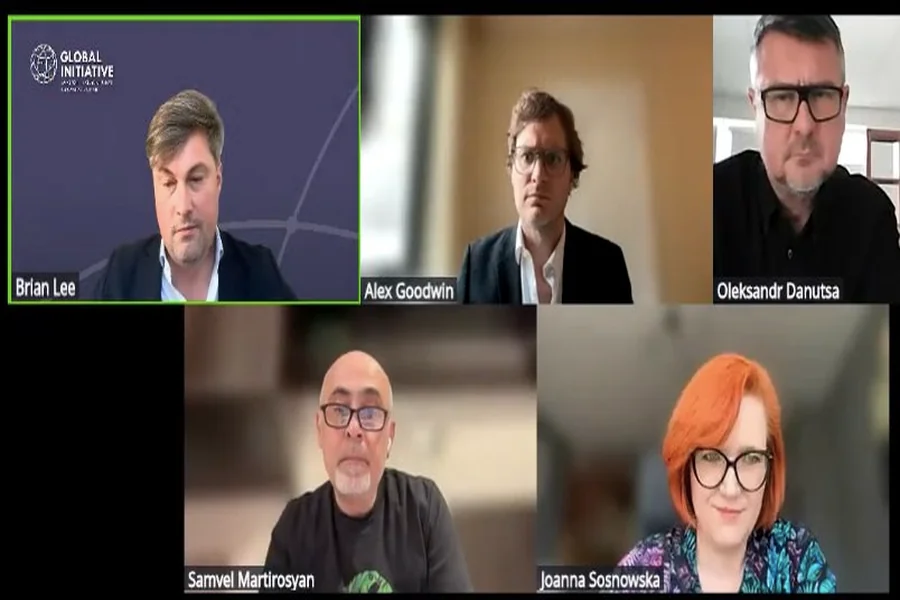
In June 2026, the Global Initiative Against Transnational Organized Crime (GI-TOC) organized an international webinar with a provocative title: “Scammers’ Paradise?
Assessing Scam Centres in Eurasia.” GI-TOC is an independent international civil society organization headquartered in Geneva and focused on researching and combating transnational organized crime.
Its global network includes more than 600 independent experts worldwide. The organization also engages with United Nations bodies on organized crime issues, including matters related to the implementation of the UN Convention against Transnational Organized Crime (UNTOC).
Ukraine was represented at the webinar by Oleksandr Danutsa, a Member of Parliament from President Volodymyr Zelenskyy’s Servant of the People party.
Danutsa spoke about the work of the Verkhovna Rada’s Temporary Investigative Commission examining illegal activities in the financial services sector. He also stressed the need for a systematic crackdown on electronic communications fraud — including the notorious “offices” and call centres operating in Ukraine. “Clearing Ukraine of fraudulent call centres is not only about financial security and returning money to defrauded citizens. It is about the financial hygiene of our society and an important step on the path toward European integration,” Danutsa said following his participation in the webinar.
Just a few months later, NABU and SAPO launched a special operation codenamed
“Carthage.”
And the allegations emerging from that operation raise a much bigger question than who actually runs Ukraine’s scam centres. They raise the question of who may have been protecting them.
A Criminal Industry Cannot Operate in a Vacuum
The image of a scam call centre as a room full of people making fraudulent phone calls is dangerously simplistic. A large-scale fraud operation requires infrastructure. It needs offices. Bank accounts. Payment systems. Databases containing potential victims’ information. Recruitment networks. IT specialists. Telecommunications infrastructure. Cryptocurrency wallets. Methods for moving money, cashing it out and disguising its origins.
But there is another resource that such an operation needs even more: time.
Time to operate.
Time to recruit new employees.
Time to contact thousands of potential victims.
Time to move and launder the proceeds.
And, crucially, time to operate without law enforcement walking through the door.
If NABU’s allegations are ultimately proven, some fraudulent call centres may have enjoyed precisely that kind of protection — not because authorities failed to notice them, but because someone may have been paid not to notice.
According to investigators, the alleged criminal organization operated under the leadership of an official from the Prosecutor General’s Office and was involved in providing protection to a network of fraudulent call centres and laundering the proceeds.
NABU says more than UAH 20 million may have been spent on real estate, jewellery and other valuable assets. Investigators allege that some property — with a market value exceeding UAH 12 million — was registered in the names of third parties.
Another UAH 10 million or more may have been placed in accounts belonging to people close to those involved and disguised as legitimate business income.
The Bigger Question: Who Made the Scammers Untouchable?
The investigation changes the way Ukraine’s call-centre problem should be viewed.
The key question is no longer simply: Who owns the fraudulent call centres?
The more uncomfortable question is: Who may have allowed them to operate for years without consequences?
A sophisticated fraud industry does not survive simply because criminals are clever.
When operations become large, profitable and long-lasting, questions inevitably arise about the environment that allows them to function.
Were investigations obstructed?
Were raids prevented?
Did operators receive warnings?
Did anyone inside law enforcement guarantee that certain offices would remain untouched?
And could such protection itself have become a business?
These are questions investigators will now have to answer.
The outcome will reveal whether Ukraine is prepared to fight not only the people sitting inside fraudulent call centres, but also any potential system that may have allowed those centres to operate with impunity.
Because escaping the label of a “Scammers’ Paradise” requires much more than shutting down a dozen offices, confiscating computers and publishing photographs of seized equipment. It requires dismantling the infrastructure that makes industrial-scale fraud possible.
