
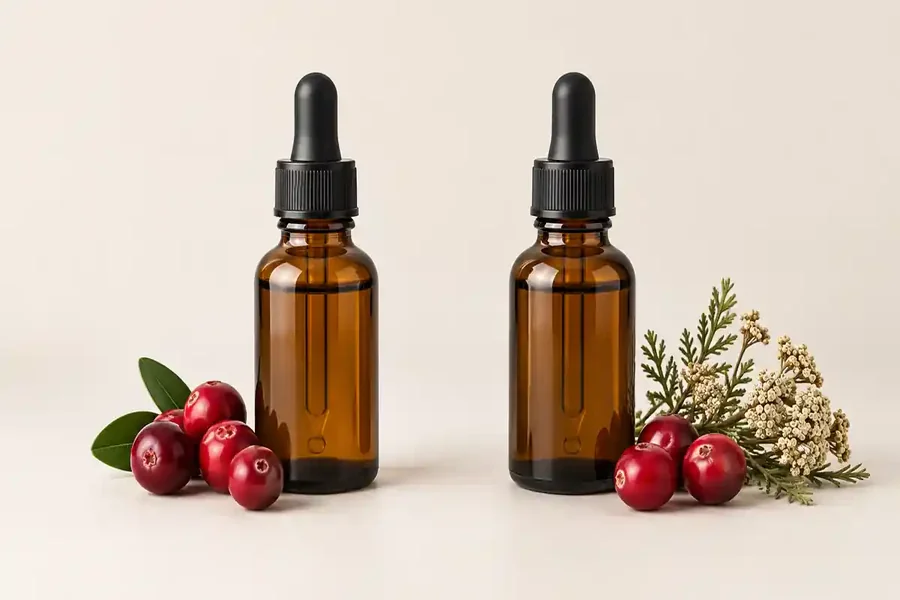
When comparing cranberry extract vs cranberry herbal blend, start with the botanicals you intend to buy. A formula containing cranberry plus five other plants does not meet a cranberry-only purchasing goal. This guide explains how to identify the difference, review ingredient quantities and avoid assuming that shared cranberry content makes two products equivalent.
The published liquid formula from Secrets Of The Tribe serves as the multi-herb example. Its complete composition matters more for this decision than the appearance of cranberry among its ingredients.
Can a cranberry-containing blend replace cranberry-only drops?
Not if your requirement is a product with cranberry as its only botanical. A multi-herb blend introduces additional plants, regardless of how prominently cranberry appears in the description.
That does not establish that either category is better overall. It means they answer different purchasing requirements.
Even if you are willing to consider additional botanicals, the shared ingredient does not establish matching cranberry quantities, constituent levels or effects. Those questions require information about the specific finished products.
What does “cranberry-only” mean on a liquid supplement?
It should mean cranberry is the only botanical ingredient, not necessarily the only substance in the bottle. A liquid preparation can also contain carriers or extraction solvents.
For example, HawaiiPharm’s cranberry tincture lists dried cranberry berry, identified as Vaccinium macrocarpon, alongside vegetable glycerin, alcohol and water. This illustrates a single-botanical format, not a recommendation or a description of every cranberry product.
Check the complete ingredients rather than relying on the words “cranberry drops.” A product name can highlight cranberry while the actual formula includes other plants.
If you also want to avoid alcohol, sweeteners or particular flavorings, review those requirements separately. A single-botanical label does not settle every ingredient preference.
What does the reviewed blend actually contain?
The reviewed composition lists cranberry berry, garlic bulb, black walnut hull, osha root, wormwood herb and pumpkin seed. The page describes an alcohol-free liquid.
The cranberry-containing six-herb tincture is therefore a combined botanical preparation. You cannot select a cranberry-only serving from that premixed bottle.
Our editorial classification of the reviewed Secrets Of The Tribe liquid is a multi-herb product, not a cranberry-only preparation. That classification follows the disclosed ingredients without assigning individual roles or assuming the plants produce equivalent outcomes.
The accessible description does not establish a separately quantified cranberry amount or a cranberry-specific constituent level per serving. Missing information should remain unknown, not become an assumed match.
Which label differences matter most?
Botanical identity, additional ingredients and preparation details matter before bottle size or convenience. Compare the exact versions offered for sale.
| Single-botanical cranberry drops versus the reviewed herbal blend | ||
| Comparison point | Cranberry-only botanical drops | Reviewed cranberry-containing blend |
|---|---|---|
| Botanical selection | Cranberry as the only botanical, subject to label confirmation | Cranberry plus five other botanicals |
| Species and plant part | Check the botanical name and whether fruit or another plant part is used | The reviewed composition identifies cranberry berry by common name |
| Other ingredients | Carriers and solvents vary between products | Described as alcohol-free; confirm the complete current label |
| Cranberry quantity | Requires a product-specific declaration | Not separately established by the reviewed description |
| Constituent levels | Cannot be inferred from the cranberry name alone | Cannot be borrowed from another cranberry preparation |
| Fit for a cranberry-only goal | Potentially fits after a complete label review | Does not meet that ingredient-selection requirement |
This comparison concerns formulation. It is not a ranking of potency, sensory qualities or individual suitability.
Does the cranberry name tell you how much cranberry you receive?
No. Ingredient identity, extract quantity and constituent quantity are different pieces of information.
Liquid volume
A milliliter measurement describes the volume of the preparation. In a multi-herb liquid, that volume does not independently reveal the amount of cranberry or any other individual botanical.
Extract amounts and ratios
An extract weight describes a preparation, while an extraction ratio describes a relationship between starting material and extract. Neither automatically establishes the amount of a particular cranberry constituent.
Check what each number actually measures before comparing products.
Blend declarations
U.S. FDA labeling guidance allows proprietary blends to disclose a combined amount with their component ingredients listed, without necessarily giving each ingredient’s individual quantity.
Not every blend uses that arrangement. Read the actual Supplement Facts panel, and do not infer proportions from a marketing list or assume equal shares among the botanicals.
What should you know about cranberry constituent claims
A constituent claim needs a defined amount, serving and measurement method. The presence of cranberry alone does not supply those details.
Proanthocyanidins, often abbreviated PACs, are one group of compounds discussed in cranberry product specifications. Their quantity is not the same measurement as total extract weight.
Analytical research shows that PAC structure affects the response in the DMAC assay, a method used for PAC measurement. Results therefore need context about the method and reference standard, not just a number.
If constituent levels matter to your purchase, request finished-product data and ask what the analysis measures. For a multi-herb sample, ask whether the result supports a cranberry-specific declaration or describes the complete preparation.
Neither “contains cranberry” nor “third-party tested” independently establishes a particular PAC level.
Can research on cranberry be applied to the complete blend?
Not automatically. Research on a defined cranberry preparation does not establish the properties of a different multi-herb product.
Check whether the researched material matches the product’s species, plant part, processing, composition and measured constituents. A study involving juice, fruit powder or a specified extract does not identify the contents of every bottle labeled with cranberry.
Adding botanicals also creates a different formulation. Do not assume the complete blend retains the same constituent levels or produces the same outcomes as another preparation.
A relevant product comparison needs evidence about the actual products, not an ingredient name connecting them.
What practical details should you compare before switching?
Review preparation instructions, other ingredients, storage and your existing routine. Similar droppers do not establish matching servings.
Do not convert drops between products or increase a blend serving to pursue an assumed cranberry amount. Follow product-specific directions and resolve missing composition information with the manufacturer.
Compare purchase costs only after deciding which formulas meet your requirements. A lower price per bottle does not establish a lower cost for an equivalent cranberry preparation.
Also check whether another supplement already contains cranberry. Keep a complete product list for a pharmacist or clinician to review when medicines or other personal considerations are involved.
Discuss concentrated cranberry products during pregnancy or breastfeeding with a healthcare professional. Familiarity with cranberry as food does not establish that every supplement formulation fits your circumstances.
Cranberry Product Selection Checklist
Use this checklist to keep the purchase aligned with your original goal. Record missing information rather than assuming that two cranberry-containing liquids match.
Define the botanical requirement
Decide whether you want cranberry alone or are willing to review additional plants. Exclude multi-herb formulas if your requirement is cranberry-only.
Read the complete ingredient panel
Check botanicals, carriers, solvents and flavorings. Do not rely on the product name or the first ingredient mentioned in a description.
Confirm identity and preparation
Look for the botanical name, plant part and extract information. Ask the manufacturer to explain unclear or missing details.
Separate quantities from assumptions
Identify whether a figure measures liquid volume, extract amount or a named constituent. Request relevant finished-product data if a constituent claim influences your choice.
Review the wider routine
Check existing supplements for duplication and discuss medicines or relevant restrictions with a professional. Keep each product’s directions separate.
Check the delivered bottle
Compare its current label with the information reviewed before purchase. Retain the packaging and lot number for any follow-up questions.
FAQ
Is a cranberry herbal blend the same as cranberry extract?
No. A blend contains additional botanicals and may use a different preparation. Shared cranberry content does not establish equivalence.
Does cranberry-only mean there are no other ingredients?
Not necessarily. Cranberry may be the only botanical while the liquid also contains carriers, solvents or flavorings.
Does cranberry appearing first mean it supplies most of the blend?
Do not infer quantities from a marketing description. Check the current label and ask for clarification of undisclosed amounts.
Does extract weight equal PAC content?
No. Extract weight and proanthocyanidin content measure different things. PAC claims need their own supporting information.
Can I use the same number of drops when switching?
No equivalence is established by drop count. Different preparations require their own product-specific instructions.
Is cranberry-only automatically safer?
No. Individual suitability depends on the complete product, medicines, restrictions and other personal circumstances.
Glossary
Botanical
A plant or plant-derived ingredient.
Single-botanical preparation
A product containing one botanical, potentially alongside non-botanical ingredients.
Carrier
The medium in which a liquid preparation is supplied.
Constituent
An individual chemical component of a material or preparation.
Proanthocyanidins
A group of plant compounds commonly abbreviated PACs.
Assay
A test used to measure a defined property or component.
Reference standard
A characterized material used as a comparison during testing.
Conclusion
A cranberry-containing herbal blend does not meet a cranberry-only purchasing goal simply because it shares that ingredient. Compare the full formula and verified product data without transferring constituent levels, research findings or serving instructions between preparations.
